


|
|
|
Shundo
Aoyama
 In
the afternoon:
In
the afternoon: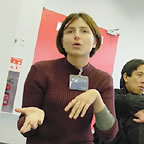 We
came back to the college and each member announced his or her personal record
within the group. Again, discussion about the theme and the mode of presentation
was challenging.
We
came back to the college and each member announced his or her personal record
within the group. Again, discussion about the theme and the mode of presentation
was challenging.
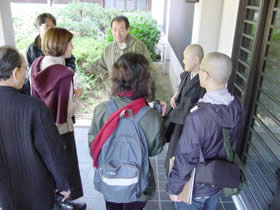
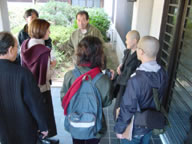 We
wanted to do what could be done only in this workshop, and set out to do fieldwork
without determining a theme beforehand. We visited various places, saw things,
and let ourselves feel genuinely free. We had an experience in the Zen temple
that gave us a notion for our theme; in the temple yard, beneath the great bell
tower, we saw some footwear, each with a single stone placed upon it. All of us
thought that the stones must be imbued with some specific, religious meaning.
But we soon found out that the stones were only there as weights, to keep the
wind from blowing the footwear away. The misunderstanding fascinated us.We were
also intrigued by the curiosity of one of our international participants, Maria,
who came from Poland. She was interested in every object and every shape in the
temple yard. We realized immediately that even though we may share space and time,
our thoughts and perceptions are as individual as we are.
We
wanted to do what could be done only in this workshop, and set out to do fieldwork
without determining a theme beforehand. We visited various places, saw things,
and let ourselves feel genuinely free. We had an experience in the Zen temple
that gave us a notion for our theme; in the temple yard, beneath the great bell
tower, we saw some footwear, each with a single stone placed upon it. All of us
thought that the stones must be imbued with some specific, religious meaning.
But we soon found out that the stones were only there as weights, to keep the
wind from blowing the footwear away. The misunderstanding fascinated us.We were
also intrigued by the curiosity of one of our international participants, Maria,
who came from Poland. She was interested in every object and every shape in the
temple yard. We realized immediately that even though we may share space and time,
our thoughts and perceptions are as individual as we are.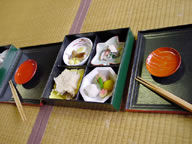 Afterwards,
we talked and determined a theme based on our experiences in the Zen temple. We
came to the conclusion that if we share the same physical space, by knowing what
someone else feels or thinks, we can see the differences in our sensibilities.
Through this experience we can understand one another and build a new relationship.
At the same time, the same kind of process goes on when we change our judgement
or image of others. We realized that this relationship we were forming would continue
to change endlessly, both during and after the workshop.
Afterwards,
we talked and determined a theme based on our experiences in the Zen temple. We
came to the conclusion that if we share the same physical space, by knowing what
someone else feels or thinks, we can see the differences in our sensibilities.
Through this experience we can understand one another and build a new relationship.
At the same time, the same kind of process goes on when we change our judgement
or image of others. We realized that this relationship we were forming would continue
to change endlessly, both during and after the workshop.

 |
 |
 |
| Maria Gorska Competion Winner |
Kenji Wada Aichi Pref. University of Fine Arts & Music |
Akiko Amaha Musashino Art University |
 |
 |
 |
| Takuya Kokura Nagoya City University, School of Design and Architecture, graduate school |
Yoshikazu Komori Nagoya University of Arts, graduate school |
Hidehumi Hayashi Nagoya Zokei University of Art & Design |