


| |
|

 November
11th
November
11th In
the morning:
In
the morning:
 While
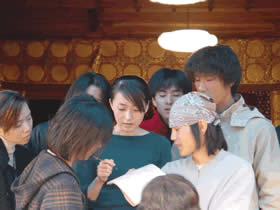
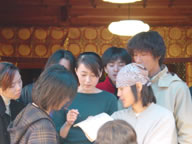
conducting our fieldwork, we became interested in our group's internal communication.
We had two designers from abroad, one from Hong Kong and one from Taiwan; Chinese
characters were our common denominator, and played a great role in our communication,
especially because our English was inadequate to our desire to communicate. These
two factors made our mode of communication very specific and aroused our interest
in communication in general.
While
conducting our fieldwork, we became interested in our group's internal communication.
We had two designers from abroad, one from Hong Kong and one from Taiwan; Chinese
characters were our common denominator, and played a great role in our communication,
especially because our English was inadequate to our desire to communicate. These
two factors made our mode of communication very specific and aroused our interest
in communication in general. The
designer from Hong Kong (where Cantonese is spoken) explained some stories he
had heard in Pekinese to the Japanese students using Chinese characters, drawings,
and some English. I am not sure if we fully understood his explanations.In the
course of this communication, we rediscovered that Chinese characters, which convey
meaning not by pronunciation, but by shape, effected reciprocal understanding
under the circumstances. This pointed us toward the appropriate emphasis of our
presentation.
The
designer from Hong Kong (where Cantonese is spoken) explained some stories he
had heard in Pekinese to the Japanese students using Chinese characters, drawings,
and some English. I am not sure if we fully understood his explanations.In the
course of this communication, we rediscovered that Chinese characters, which convey
meaning not by pronunciation, but by shape, effected reciprocal understanding
under the circumstances. This pointed us toward the appropriate emphasis of our
presentation.
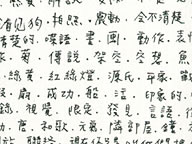 Speaking, writing, drawing. We edited a short film showing
the importance of Chinese characters and scenes of our communication, in which
we used our perceptions to their fullest.
Speaking, writing, drawing. We edited a short film showing
the importance of Chinese characters and scenes of our communication, in which
we used our perceptions to their fullest.
 |
 |
 |
| Hsiu Wen-Chen Competion Winner Taiwan |
Jack Chan Ka Ki Competion Winner Hong Kong |
Yosuke Kudo Musashino Art University |
 |
 |
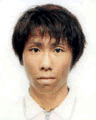 |
| Toshikatu Funayama Nagoya City University, School of Design and Architecture, graduate school |
Akiko Hattori Aichi Pref. University of Fine Arts & Music, graduate school |
Fumiaki Murakami Nagoya Zokei University of Art & Design |