


| |
|
Jiro
Nakayama
 November
11th
November
11th In
the afternoon:
In
the afternoon:

 The
only member from abroad moved into another group on the first day. Afterwards,
we were joined by an interpreter who was interested in Japanese lacquerware.
So our fieldwork started with Japanese students and an interpreter from Singapore.
The
only member from abroad moved into another group on the first day. Afterwards,
we were joined by an interpreter who was interested in Japanese lacquerware.
So our fieldwork started with Japanese students and an interpreter from Singapore.
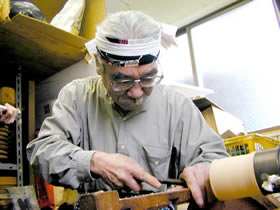
"Studio Jiro" was located next to Jiro's home and consisted of a room
only six tatami mats in size, with his work on display and a small working space
enclosed by glass screens. Jiro wore a pair of glasses, tied his grey hair up
into a knot, and was always smiling. His figure differed completely from the
image of 'craftsman' that we had harbored up until then. He liked to drink and
was very gentle.
 We
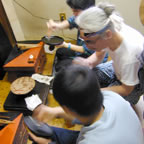
spent two days with him. His wife once brought us a supply of 'Takoyaki' (hot
octopus dumplings) and beer and told us about his daily routine. His drinking
habit must be influencing his work. When he drew, the brush in his hand trembled.
When he spread gold leaves on ware, they fell about him. We were greatly moved
to learn that his way of life was so strongly reflected in his work.
We
spent two days with him. His wife once brought us a supply of 'Takoyaki' (hot
octopus dumplings) and beer and told us about his daily routine. His drinking
habit must be influencing his work. When he drew, the brush in his hand trembled.
When he spread gold leaves on ware, they fell about him. We were greatly moved
to learn that his way of life was so strongly reflected in his work.
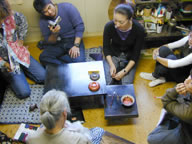
At first, we tried to discover what might be the perceptional capabilities of
a professional. But we finally chose his personality as our theme, as it differed
so from our conventional image of a professional craftsman. The discrepancy
was one reason, but at any rate we were attracted by his humane existence. He
did not spend much time engaging in his own work but guided us in coating and
drawing pictures with japan. He kept saying that he wanted us to know about
'japan'. We took notes as he spoke, and were ready with these for the final
presentation.


 |
 |
 |
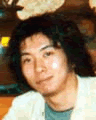
| Satoru Hasegawa Musashino Art University, graduate school |
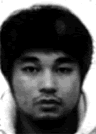
So Kobayashi Musashino Art University |
Nobuyuki Inaha Nagoya University of Arts |
 |
 |
|
| Reiko Nara Nagoya City University, School of Design and Architecture, graduate school |
Yuichi Harada Aichi Pref. University of Fine Arts & Music |