

| |
|
Makoto
Tajiri (Member of Japan Craft Design Association, Inc.)
 In
the afternoon:
In
the afternoon: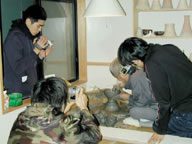 We
got together at the station near his studio and had a lunch of grilled meat, a
common Seto meal. Afterwards, we asked Mr. Tajiri to work on a piece of pottery
blindfolded. We left his studio late in the evening and rushed back to edit the
films we recorded.
We
got together at the station near his studio and had a lunch of grilled meat, a
common Seto meal. Afterwards, we asked Mr. Tajiri to work on a piece of pottery
blindfolded. We left his studio late in the evening and rushed back to edit the
films we recorded.

 Our
group visited the studio of Mr. Tajiri, a ceramist living in Seto near Nagoya
City. The world of ceramics was new to most of us, and we were most interested
in his perceptions; which ones would a ceramics professional use and how would
he transform clay into a piece of art? His studio was infinitely interesting.
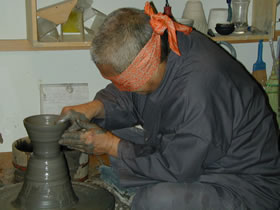
When Mr. Tajiri worked on the pottery wheel, the clay changed shape as if it
were alive; this was incredible. We were moved all the more deeply after we
tried working on the wheel ourselves. We were also impressed by the fact that
he worked not only through intuition, but also taking into consideration the
clay's rate of contraction when fired at high temperatures, and his use of a
guage-like instrument (called a Tombo), which reproduced the shape of a piece.
Our
group visited the studio of Mr. Tajiri, a ceramist living in Seto near Nagoya
City. The world of ceramics was new to most of us, and we were most interested
in his perceptions; which ones would a ceramics professional use and how would
he transform clay into a piece of art? His studio was infinitely interesting.
When Mr. Tajiri worked on the pottery wheel, the clay changed shape as if it
were alive; this was incredible. We were moved all the more deeply after we
tried working on the wheel ourselves. We were also impressed by the fact that
he worked not only through intuition, but also taking into consideration the
clay's rate of contraction when fired at high temperatures, and his use of a
guage-like instrument (called a Tombo), which reproduced the shape of a piece.
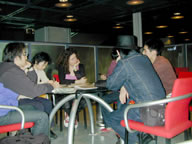 After
our visit on the first day, we talked about how we would spend the second day
at his studio preparing for our presentation. We were interested in so many
things there. In the end, we agreed not to interpret the craftsman's perceptional
capabilities, but to focus on them while allowing the audience to share with
us as much as possible the discernible but inexplicable "intensity".
After
our visit on the first day, we talked about how we would spend the second day
at his studio preparing for our presentation. We were interested in so many
things there. In the end, we agreed not to interpret the craftsman's perceptional
capabilities, but to focus on them while allowing the audience to share with
us as much as possible the discernible but inexplicable "intensity".
 On
the second day, we prepared several video cameras and filmed Mr. Tajiri working.
We concentrated on the relationship between the movement of his whole body and
his hands. We also tried to compare the respective conditions of him working
in his usual manner and working blindfolded. No matter how he worked, we found
that the number of the wheel's rotations synchronized with the rythmic motion
of his body. We wondered at the border between the clay and the hands. There
were some operations in which he failed because he was blindfolded, and some
in which he succeeded despite the blindfold.
On
the second day, we prepared several video cameras and filmed Mr. Tajiri working.
We concentrated on the relationship between the movement of his whole body and
his hands. We also tried to compare the respective conditions of him working
in his usual manner and working blindfolded. No matter how he worked, we found
that the number of the wheel's rotations synchronized with the rythmic motion
of his body. We wondered at the border between the clay and the hands. There
were some operations in which he failed because he was blindfolded, and some
in which he succeeded despite the blindfold.
Afterward, we were served tea. Mr. Tajiri's son joined us and chatted in English
with the international prizewinners of Nagoya Design Do. We all had a pleasant
time over tea talking with his family and the English-speaking designers. We
were very satisfied by the experience, and admired the depth of Mr. Tajiri's
work. We then began to prepare for our presentation.
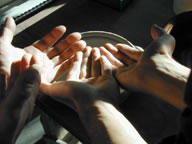 "If
possible, the product should be handy, inexpensive, and beautifully formed,
but in the end, the user is the judge."
"If
possible, the product should be handy, inexpensive, and beautifully formed,
but in the end, the user is the judge."
"We cannot say that all machine-made products are no good. Some shapes
are better made by machines, and some can only be produced beautifully by hand."
"Rhythms are important. When your heart is in turmoil, something always
goes wrong. When you keep working on the process, you calm down and tranquility
embraces you."
"A craftsman needs each and every sense; Our work is dependent on all five."
Our experience was interesting and exceptionally wonderful.


 |
 |
 |
| Thea L.Bjerg Competion Winner Denmark |
Sarawut Chutiwongpeti Competion Winner Thai |
Oded Ezer Competion Winner Israel |
 |
 |
 |
| Kayoko Yano Competion Winner Japan |
Yuichiro Matsui Musashino Art University |
Takehide Sawada Aichi Pref. University of Fine Arts & Music, graduate school |
 |
 |
|
| Tsuyoshi Nagura International Design Center NAGOYA Inc. |
Takako Hikosaka International Design Center NAGOYA Inc. |