


| |
|
Shigenari
Yasui
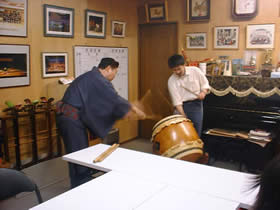
 For
all of the group members, it was the first time in our lives we had ever heard
the traditional flat drum. We were all shocked by the fierceness of its sound.
The impact it had on us influenced the direction of our presentation.
For
all of the group members, it was the first time in our lives we had ever heard
the traditional flat drum. We were all shocked by the fierceness of its sound.
The impact it had on us influenced the direction of our presentation.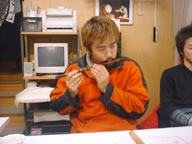 We
decided to ask Mr. Yasui several questions; what the sound of drums was, what
he felt, and the relationship between human beings and the sound of drums. The
sound of drums reminded us of the heartbeat of our mother we heard in her womb.
That was because we were inspired by its sound.
We
decided to ask Mr. Yasui several questions; what the sound of drums was, what
he felt, and the relationship between human beings and the sound of drums. The
sound of drums reminded us of the heartbeat of our mother we heard in her womb.
That was because we were inspired by its sound.
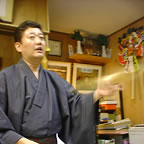 In
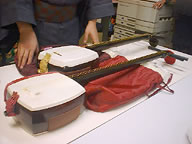
the two-day fieldwork our group was able to listen to traditional Japanese musical
instruments, including drums, flutes, and the shamisen. Mr. Yasui began by drumming
for us. We were both shocked and impressed by the fierceness of its sound. The
feelings aroused within us remained with us until we reviewed our experience with
the musician.
In
the two-day fieldwork our group was able to listen to traditional Japanese musical
instruments, including drums, flutes, and the shamisen. Mr. Yasui began by drumming
for us. We were both shocked and impressed by the fierceness of its sound. The
feelings aroused within us remained with us until we reviewed our experience with
the musician. 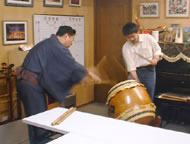 We
returned to the college to prepare to review our exercise. While talking about
what we felt and how to present it, we realized that there were several questions
we would like to ask Mr. Yasui.
We
returned to the college to prepare to review our exercise. While talking about
what we felt and how to present it, we realized that there were several questions
we would like to ask Mr. Yasui.

 |
 |
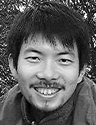 |
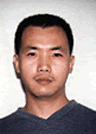
| Jason Ong Kian Koo Competion Winner Singapore |
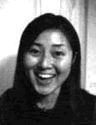
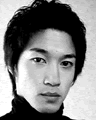
Akane Wachi Musashino Art University |
Hideki Yano Competion Winner Japan |
 |
 |
 |
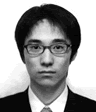
| Masayuki Katsuyama Nagoya City University, School of Design and Architecture, graduate school |
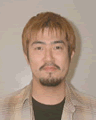
Takayoshi Matsui Nagoya Zokei University of Art & Design |
Keiichiro Maeno Product Designer |